A "good climate"... with Attila upgraded
Qualitative and numerical: 155mm Firtina 2 howitzers, anti-tank systems linked to drones, early-warning radar, electronic warfare systems and armored infantry combat vehicles.

Dr. Yiannos Charalambides, International Relations
While talk continues regarding a positive climate between President Christodoulides and the occupation leader Tufan Erhürman, Turkey continues to upgrade its forces in the occupied areas — both qualitatively and quantitatively.
New weapons systems
How, therefore, is Turkey upgrading its military presence in Cyprus, specifically Attila? As “Simerini” had revealed, by late October to early November at least three shipments were made from the Turkish coastline to the occupied port of Famagusta, transporting heavy weaponry.
The qualitative and numerical upgrades involve:
- Artillery:
Deployment to the occupied areas of the Turkish T-155 Firtina 2 howitzer — an advanced version of the Firtina 1. The Firtina 2 enhances fire support capability. The gun barrel is slightly longer than that of the previous model and offers greater accuracy, as it is integrated into a network of weapon systems — UAVs (drones) and radar — providing live imaging, precise coordinates and rapid reaction, with a firing range of 40 km. Importantly, the Firtina 2 arrived without the Firtina 1 being withdrawn. Thus, the upgrade is both qualitative and numerical. - Anti-tank systems:
Two types have been transferred. The first, “Pars”, comparable to the Israeli Spike used by the National Guard. It does not require line-of-sight fire and can bypass terrain obstacles, striking behind hills and targeting the tank roof — its weakest spot.
The second, “KAPLAN STA”, is linked to UAVs and electro-optical systems, offering real-time target imagery and precision at ranges of 8–32 km. - Air defence:
The “KORKUT” — an armored vehicle with an unmanned turret equipped with twin 35mm cannons and radar capable of locking onto low-altitude UAVs and helicopters. With a 4 km range, it forms part of the short-range layer of Turkey’s air-defence shield but can also engage ground targets. This and other systems are networked through “HERIKKS AIR” nodes, connected to radar and forming part of an early-warning structure. - Armored personnel carriers:
ZMA-15 infantry fighting vehicles with unmanned remote-controlled turret and 25mm cannon. Featuring a modern fire-control system and the ability to fire on the move, these vehicles are essentially upgraded M-113 APCs. First sighted in an exercise of the 39th Division three years ago, their steady deployment since suggests partial or complete replacement of the existing M-113 and Nurol APC fleet.
Increase of threat & diplomatic implications
With these developments:
A) The Turkish threat increases.
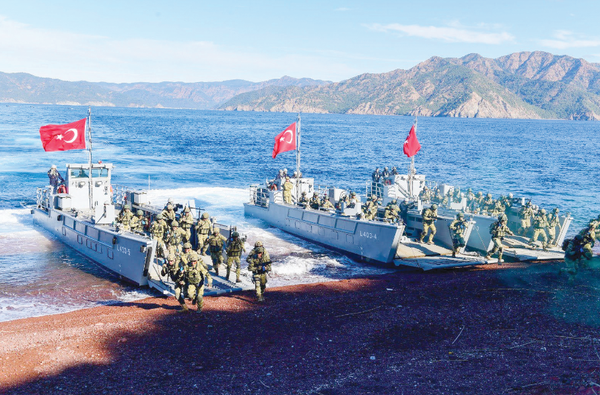
B) The balance of forces widens — with direct consequences for negotiations. And this concerns not only Cyprus, but the wider region. From 22 November to 3 December, the exercise "Eastern Mediterranean-2025 (DOĞU AKDENİZ-2025)" is underway, involving U.S. Marine units. These forces conducted joint amphibious landing training on Yılancık Island near the Akzaz naval base — close to the Aegean gateways (Crete–Karpathos–Rhodes), over which Ankara seeks control.
From 24–28 November, the same exercise ran concurrently with air-naval maneuvers off Karpasia, aligned with the Turkish strategic doctrine that the stretch from Marmaris to Alexandretta constitutes a Turkish lake.
C) Turkey thus strengthens its diplomatic position and inflexibility regarding Cyprus and the Aegean. In contrast, the continued reinforcement of the National Guard is justified — and the reactions of Erhürman and Ankara are not.
A unified security architecture
Under these conditions, Turkey makes its intentions clear: it will not accept full withdrawal of Attila forces from Cyprus because the island is integrated into Turkey’s armed structures and broader security architecture. Cyprus is considered part of the unified geostrategic space of the “Motherland”, non-negotiable, within the “Blue Homeland” doctrine and the revisionist vision of a new Ottoman sphere.
The peace of cemeteries — and the EU
According to Realist doctrine, any change in Ankara's stance on Cyprus or the Aegean could only arise via shifting interests with other powers and particularly through reactivation of the Single Defence Doctrine to restore deterrence and rebalance military power through Greek presence in the region. Such doctrine must be accompanied by diplomatic initiatives within and beyond the EU to impose cost on Turkey for the occupation rather than facilitating it, as is currently the case.
So let us begin with the most basic question:
Will President Christodoulides raise the issue of the qualitative and numerical enlargement of the occupation forces with the new UN Secretary-General’s Representative in Cyprus, Colin Stewart’s successor, Kassim Diagne — and will this then be brought to António Guterres?
Are Turkish actions contributing to a “good climate”? Should this information not be placed before our EU partners — and has it been? Even before the United States.
For Turkish policy builds not pillars of stability but of threats and tension. Unless what Turkey seeks is our submission — and, if necessary, its imposition through military superiority, establishing the peace of cemeteries, as in 1974.
Is that the peace being discussed?

The upgraded T-155 Firtina-2 features a fully electric turret and gun drive system, a redesigned automatic loading mechanism, and the ASELSAN SHARP remote weapon station equipped with a 12.7 mm machine gun.

AIR DEFENCE EARLY WARNING & C4I SYSTEM**
HERİKKS is an Air Defence Early Warning and C4I System that manages air-defence operations at the tactical level. It receives air-threat information from multiple radars, generates a real-time Recognized Air Picture, and assigns available air-defence weapons to designated targets. The system operates under a unified command-and-control structure, integrating air-defence weapons, air-defence radars, communication equipment and command-and-control software. It is fully interoperable.
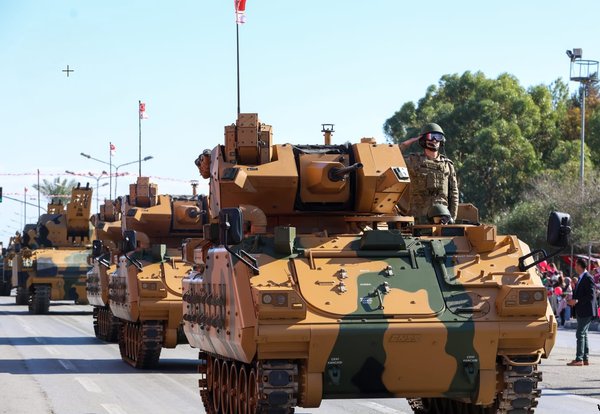
Specifications of the ZMA-15 Personnel Carrier:
- NEFER unmanned weapon turret
- SPIDER 360° short-range surveillance suite
- Surveillance and observation system
- Direction-finding and navigation system
- Laser Warning System (LWS)
- Driver Vision System (DVS)
- CBRN protection
- Crew display interfaces
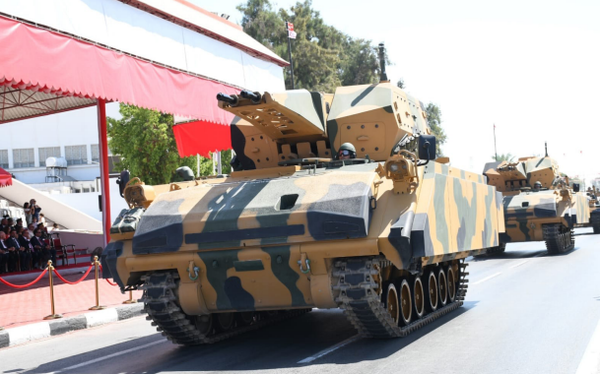
The KORKUT air-defense system consists of armored tracked vehicles with modernized ACV platforms, developed for the effective protection of mechanized troops and mobile units. It provides:
- 35 mm airburst ammunition capability — also produced by ASELSAN — which significantly increases the effectiveness of ground-based air defence against modern aerial threats, including air-to-ground missiles, cruise missiles and UAVs.
- Automatic target tracking via an integrated platform equipped with radar and sensors.
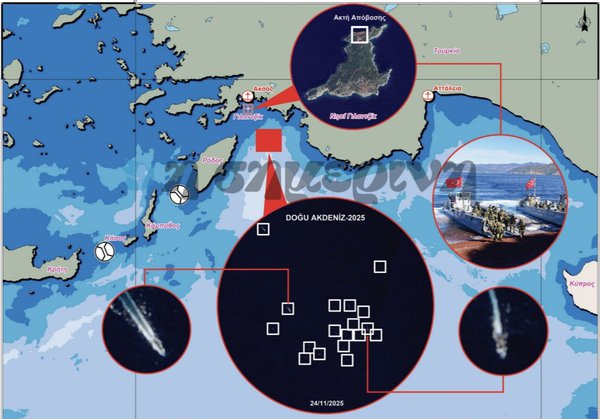
The map and satellite images depict part of the exercise codenamed “Eastern Mediterranean-2025.” On 26/11/2025, joint training was conducted between the Turkish Navy amphibious infantry units and the United States Marine Corps, near the gateways of the Aegean, on the island of Yılancık. At the same time, information was released regarding the exercise “National Eagle-2025/2” taking place in Konya from 24/11 to 5/12.

KMC-U launcher with ASELFLIR-410 mounted on a KAPLAN STA armoured vehicle.