Non-Aggression Pact from Russia… but with annexation of territories
Can the Ukrainian issue become a precedent for Cyprus or not?

By Dr Yiannos Charalambides, International Relations
While the special envoy of the UN Secretary-General on the Cyprus issue, María Ángela Holguín Cuéllar, is in Cyprus for yet another attempt to resolve the Cypriot Gordian knot, in the Ukrainian issue, the President of Russia, Vladimir Putin, set red lines in the settlement process. And it is evident that he has, at least partially, the favour of the USA, at the same time that the Russian President wants the EU and its member-states to play a secondary role, meaning that, for now, they should not contribute substantially to the basic form of the solution. Turkey, on the other hand, seeks an important role, claiming that it promoted the peace process with the Istanbul meetings. Hence, the fact that it insists on being included among the guarantor powers and even in a leading role. The related question is whether the Ukrainian case can become a precedent for Cyprus.
Guarantees and mediators
Not only the issue of guarantees, but a series of matters could be linked to the Cyprus issue or even serve as a precedent or material for it. In the Ukrainian issue, the main mediating role is held by the leader of the planet. And even so he struggles to find the solution because, as in the case of Cyprus, he does not only pressure the weaker side, but mainly the stronger one, which sets its own limits. As diplomatic sources report to “S”, President Putin has set the following baseline points for a settlement:
Territorial
First: The issue of Crimea, Donetsk, and Luhansk is outside discussion. These areas will remain under Russian sovereignty. Internal procedures have already been set in motion and they constitute Russian provinces. Because, according to Moscow’s argument, historically indigenous Russian populations reside there, who decided to live with Russia because the Ukrainian state violated their human rights through the use of neo-Nazi groups. What does Putin request, then? The legitimization of what was gained through war, via the signing of an agreement with Ukraine.
Question: Will Zelensky sign something like this? Will it not be considered treason? How will he escape the pressure of both Russians and Americans? Will he rely on Europeans? How, when without the USA he cannot cope with Moscow on the battlefield? With what weapons and which funds will he resist?
On the other hand, what will the Europeans do, who have placed their own red line: that they will not accept that the Ukrainian territories gained through war pass to Russia, because this constitutes violation of borders through force, referring to the Helsinki Final Act on inviolability of borders and Article 2(4) of the UN Charter, which constitutes jus cogens (compulsory law).
Properties
The territorial issue is related to the fate of Ukrainians living in the regions which Russia wishes to place permanently under its control. What becomes accepted from Moscow is the following:
A) Ukrainians may remain, but they and their properties will fall under Russian sovereignty. They will have the right to dual citizenship. They will receive Russian citizenship but may retain Ukrainian citizenship if they wish.
B) If they choose to leave those areas, they will not have Russian citizenship, while regarding their properties, compensation procedures will be possible, if they so choose. The Russians do not clarify whether they will accept the preservation of the properties of those who choose to live under Ukrainian territory on what will be Russian-acquired land.
Power
The Russian public position is as follows: If no agreement is signed, then we will take on the ground what will not be given through negotiations now, or even more later.
‘Buffer zone’ and guarantees
Second: Russia accepts the creation of a buffer zone between its forces and those of Ukraine with the signing of a solution. It is ready to accept a relevant Security Council resolution, in which it participates, that would define aerial surveillance by the USA. The presence of foreign troops is not excluded. Moscow, however, does not accept forces from European states, especially from the EU, due to the hostile stance they adopt in the war. The Russians are also suspicious toward Turkey, because it sold drones to Ukraine and is a NATO member.
NATO, security, nuclear weapons
Third: Moscow does not accept Ukraine joining NATO and demands that the maximum number of Ukrainian troops be 300,000 compared to the 800,000 it has today, without nuclear weapons and other systems considered a direct threat. It has no problem with Ukraine becoming an EU member. It is even ready to sign an International Agreement with Europeans on non-aggression between them, which will be incorporated into Russian national law. If this Non-Aggression Pact involves the EU as such, it must be ratified by its institutions and member states.
Frozen assets and reconstruction
Fourth: On the economic front, Moscow does not accept European management of Russian frozen funds found in Europe without its participation. This is stressed because Europeans argue that those funds should be given for Ukraine’s reconstruction. Moscow raises the legally correct argument that although its funds are frozen, they belong to Russia and it will decide how they will be managed. Without this meaning that part of the amount will not be allocated to Ukraine’s reconstruction. What they understand and do not want, is for the funds to return to the EU through companies of EU countries that will undertake such works, instead of Russian companies.
In a move to secure US interests, President Trump, to pre-empt Europeans, demanded that a significant amount from those frozen assets be given to the USA as compensation for the war. The request is of course suspended, but diplomatic sources do not exclude that part of the amount could be agreed between Russia and USA for Ukraine’s reconstruction.
Similarities and differences
The Ukrainian issue has similarities, but it is not exactly the same case as Cyprus. It constitutes an issue of invasion-occupation, but in the areas conquered by Russia, there existed an indigenous Russian population, whereas in Cyprus more than 82% of the occupied land and population are Greek. Turkish Cypriots moved to the north as a result of the invasion, and the settlers are a product of war crimes. Turkish Cypriots and settlers do not constitute the legitimate population. That is the Greek Cypriots. Therefore, the right to self-determination, Article 1(2) of the Charter, cannot be invoked as in Crimea or other areas where Russians were historically the indigenous population.
In the occupied areas, there is no distinct people, as occupation leader Tufan Erhürman claims. Nor administration and territory, because that is explicitly stated in UNSC Resolutions 541 and 550, as well as the decisions of the Fourth Inter-State Application and the Loizidou case, in which property rights of displaced Greek Cypriots are upheld. Corresponding rulings do not exist for Crimea and Ukraine because evidently properties there belong to “Russian-speaking” populations.
Legalization of occupation
Based on International Law, both cases rest upon violation of borders, territorial integrity, and sovereign rights through the use of force. Such constitutes violation of Article 2(4) of the UN Charter—jus cogens. Thus, without consent of Ukraine and Cyprus, the status produced by use of force cannot be legitimized, unless states begin formal recognitions and thereby create a new legal situation regardless of compatibility with International Law.
One might argue that in Ukraine territorial annexation constitutes change of borders, while in Cyprus—even under a confederal-type federation—there is a difference. It depends. Why? Because in Cyprus, the single state of the Republic of Cyprus is split into two constituent states having as their genesis the use of force: illegality. With such a solution you do not return to the prior legal order but legalize the so-called “TRNC”, its “constitution”, its “parliament”, and its “president” as co-president via a rotating system.
Therefore, if you do not return to an improved Zurich model, you accept and legalize simultaneously the faits accomplis of the invasion.
The blackmail
The Republic of Cyprus is an EU member-state and Turkey is a candidate state. Thus, there is a common legal code and a basis for solution that is however contrary to existing convergences. The dilemma is whether the basis will be Protocol 10, under which the entire Republic of Cyprus acceded to the EU, with suspension of the acquis in the north because of occupation; or whether the invasion’s results will be legitimized via a federation, confederation, or two states.
If annexation occurs in Ukraine even with Kyiv’s agreement, then why could a precedent not be set for Turkish annexation of occupied Cyprus territory if such agreement is accepted by the EU, of which the Republic of Cyprus is a member? Here arises the blackmail: either you accept one of the partition-based forms of federation, which is already evolving into confederation through its loose form, or annexation of the occupied territories to Turkey.
Safety valve and annexation…
The safeguard is, first of all, the negotiation basis, which could be none other than Protocol 10 and the 21 September 2005 Counter-Declaration on Turkey’s obligation to recognise the Republic of Cyprus in the context of its accession process. If Mr. Erhürman wants application of the acquis in the north, he must be reminded what the acquis says: that the decision is taken on the basis of Protocol 10 by unanimity—meaning by consent of the Republic of Cyprus— which he refuses to accept at the table since he considers it defunct.
If, therefore, he does not want the Republic of Cyprus alive, from which the application of the acquis in the north depends, what does this reveal he wants? Either a partition solution or the formalization of annexation of the occupied areas to Turkey. Or that he wants partition as a vehicle toward the next step, meaning annexation first of the north and later of the south…
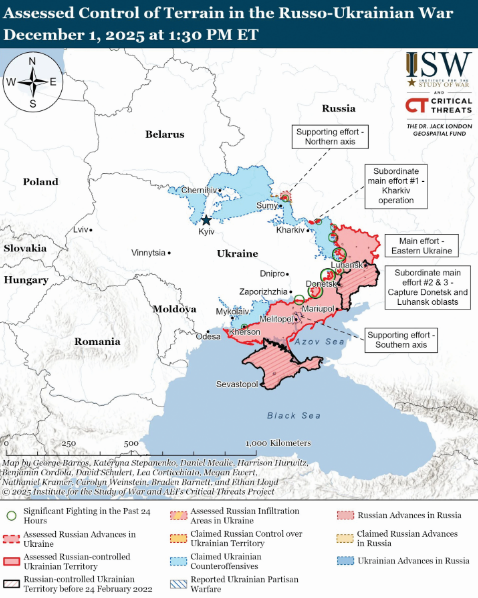
The map of the “Institute for the Study of War” shows the situation on the Ukrainian front and the areas held by Russian forces as of 13:30 on 1 December 2025.