The vise of co-sovereignty and the American Atlas
How the Cyprus issue is affected by the new U.S. strategy while the EU is in decline and China is on the rise – The role of Russia and the wealth of the Indo-Pacific

While the President of the Republic is already discussing with the occupying leader Tufan Erhürman five to six sectors of co-sovereignty within the framework of political equality and equal sovereignty, the Americans are disclosing the main pillars of their international policy. On the basis of these pillars, they seek to maintain their global dominance in a new geopolitical environment in which the EU is in decline. Since the United States is a superpower, it is logical that it has a say in issues such as the Cyprus problem, which remain unresolved. The question is whether it has the intention to intervene and to what extent, as well as whether the Cyprus problem, in the direction it is taking, can escape the power of Turkey, which largely determines and traps the settlement in the practice of a dichotomous form of solution.
The Atlas of the system and the decline of the EU
The United States no longer wants to be the Atlas of the global system, carrying all burdens and indeed the economic ones. But it will remain the dominant country in the world, with emphasis on supporting its own state sovereignty and that of its allies, within the structural logic of nation-states rather than supranational institutions, on the basis of the doctrine of a “Flexible Realism.”
These and many other things are stated in the U.S. global strategy by President Donald Trump and his associates. And their references to China, particularly to the Indo-Pacific region, are significant, as well as to Europe, which he approaches realistically in order to claim that it is in a decline due to political reasons relating to the credibility of the leadership of the EU and its member states; economic reasons due to lack of raw materials and poor planning and choices, along with the cost the EU bears from the war in Ukraine; cultural reasons associated with migration; and structural reasons relating to the institutional and constitutional framework of the EU itself as a multinational Organization and the weaknesses of its member states in taking effective decisions individually or collectively.
Economic decline of 11% and cultural erasure
According to the American document, the EU from 1990 until today has lost 11% of the share of global GDP. The following are stated: “From 25% in 1990 to 14% today — partly due to national and supranational regulations that undermine creativity and industriousness.” And the following are added: “However, this economic decline pales in comparison to the real, more tangible prospect of cultural erasure. The greatest issues that Europe faces include the activities of the European Union and other supranational bodies that undermine political freedom and sovereignty, migration policies that transform the continent and create tensions, censorship of freedom of speech and suppression of political opposition, collapsing birth rates and loss of national identities and self-confidence.
If current trends continue, the continent will be unrecognizable in 20 years or even less. Consequently, it is anything but self-evident that certain European countries will have economies and armies strong enough to remain reliable allies. Many of these nations today support twice over their existing course. We want Europe to remain European, to regain its cultural self-confidence and to abandon its failed emphasis on suffocating regulatory interventionism.”
The significance of Moscow
The United States expresses its opposition to the stance of the Europeans in the war in Ukraine, because, as they observe, what they want as an outcome — namely the defeat of Russia — is not realistic. The truth is that the Americans are building the normalization of their relations with Moscow, because their main balancing policy is with China, in the practice of a global competition, controlled by themselves, at all levels. Therefore, just as they closed the “hole” of the Middle East — as much as it can be closed — now they want to close the war in Ukraine so that there will be stabilization in U.S.–Russia relations, Russia–Europe relations, and Russia–U.S.–Europe relations. For the United States — and this is stated explicitly in the strategic document — it is self-destructive for the Western character of Europe to be lost due to migration and its continuous decline at economic and political levels, since the area of Eurasia and its periphery is considered important, in which belongs the arc from the Balkans to the Middle East, within which Cyprus, Greece and Israel fall.
Half of global GDP and the routes
This arc acquires particular significance due to the importance that the United States attributes to the “Indo-Pacific.” And why do they attribute this importance? Because their strategic report states: “The Indo-Pacific is already the source of nearly half of global GDP based on purchasing power parity (PPP) and one third based on nominal GDP. This share is certain to increase in the 21st century. This means that the Indo-Pacific is already — and will continue to be — one of the critical economic and geopolitical fields of confrontation of the next century. To prosper domestically, we must compete successfully there — and we do.” Significant is the control of sea lanes by the United States, as well as by India, whose route to Europe passes off the coast of Cyprus and from there to Greece and the rest of the Old Continent. It constitutes an alternative route to the Chinese Belt and Road, both the maritime and the land one, in which Turkey has an important role to play.
Rules of U.S.–EU alignment
Trump rings an alarm bell to Europe and indicates to it how it will be saved on the basis of the following policy axes:
First: Alignment with him on migration, which has as its goal its limitation, if not its termination.
Second: The strengthening of the nation-state and its power. It is evident from the Trump report that the United States will support Europe with politicians and policies in this philosophy, assisting in collective defense with those states which, through decline, will maintain the levels of seriousness and reliability at the level of politics and armed forces.
Third: The termination of the war in Ukraine and the restoration of relations with Russia, because Eurasia must play a balancing role regarding China. The issue is not only security but also economic and geopolitical, since the United States returns to the Monroe Doctrine — full control of the Western Hemisphere — but with Trump’s touches. This means control of the supply-chain routes and limitation of Chinese influence, giving the United States the ability to have their hands free elsewhere for its global dominance, without adopting the intense interventionism that until recently caused complications with states rather than smooth cooperation.
China and the Heart of the Earth
The goal of the United States is to increase their GDP by 2030 from 30 trillion, which it is today, to 40, in order to maintain its global power vis-à-vis China. Within this setting, the question is where Cyprus and Greece stand in relation to Turkey, which clearly belongs to the balancing actors for the United States, both in terms of power and defense and in terms of trade routes and transactions. The American strategy assists Turkey’s pendulum policy from China to Russia and to Europe due to its geopolitical position near the Heart of the Earth, that is, imperial Russia.
In the tracks of the Doctrine
If someone examines the IMEC (India-Middle East-Europe Economic Corridor), the route of India to Europe, he will perceive that it lies in the tracks of the Doctrine of the Unified Defense Space, including Israel, whose upgrading the United States seeks, as well as the further conditions of stability in its relations with Turkey and the Arab States. Such a thing would be possible in Turkey–Israel relations if Ankara changes policy, a development difficult as long as Tayyip Erdogan is in power. More likely is the scenario of a “cold coexistence” under the high supervision of the United States.
United States, Israel and Britain
The Cyprus issue is an open matter which, since it does not have an active “volcanic character,” does not create a direct threat to American interests. “We will intervene,” their strategic document writes, “where our interests are threatened.” As a result, it is possible that the existing de facto situation will be accepted by them so as not to displease Turkey and Greece, which are NATO allies, or either of the two, or even Israel, which would not want to see Cyprus fall under full Turkish control through a federal or confederal solution. Why? Because the vital space from Cyprus to Crete is considered an Israeli lung due to lack of strategic depth and the increase of the Turkish threat through Cyprus. The reverse applies for Turkey, hence the voices against Cyprus–Israel cooperation. Ankara considers Cyprus as an inseparable part of its security, particularly within the Blue Homeland doctrine. Therefore, any relationship that strengthens Israel through Cyprus weakens Turkey if perceived as a threat. The arc from Cyprus to Greece, from Thrace to Cyprus, is an extension of defense and security within the EU and NATO, linked to broader U.S. designs toward the Indian Ocean through IMEC and otherwise. Britain is also present, acting historically in the Cyprus issue at the diplomatic level and possessing Bases, playing a significant role in the region. It is traditionally the architect of a dichotomous form of solution and a supporter of Turkey.
Hard realism and alchemies
These are equations for difficult solvers and related to the solution and the form of the Cyprus issue. Attention must be paid: Trump states in his strategic report that, for dispute resolution, he uses unorthodox methods that take into account the significance of U.S. interests and how these will be best served. If he deals with us, it is likely he will not examine the index of dichotomous character of a federation or the democratic nature of the solution. He will draw a line and place us under Turkish control, ensuring in one way or another the interests of Israel. And if this happens, it will happen because we do not care for our autonomous defense and our reliable alliance with Greece, which offer enhanced security and state sovereignty. These notions and variables are valued by Trump and by those who control the international system. If the weak does not seek its strengthening, it is left to its fate. Attention, President, to the alchemies of federation and co-sovereignty. Because flexible appeasement is subordinated to flexible American realism, all the more to the hard realism of Turkey, which has no trace of idealism.
Theoretical model
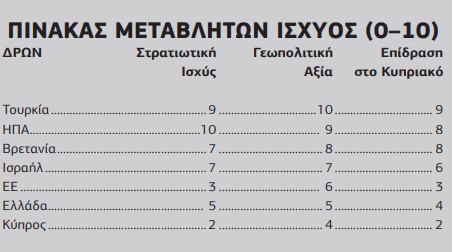
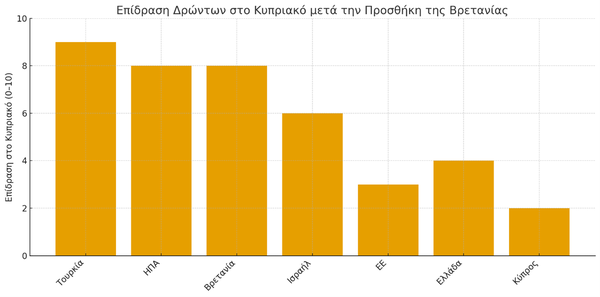
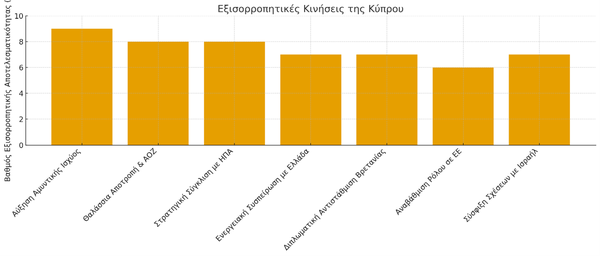
These tables are based on the theory and practice of classical Realism. They are a qualitative and not a quantitative model of variables. The scales are qualitative rather than quantitative. Based on the initial model, a new one emerges, which offers, on the basis of realism and the rules of power and geopolitics, those variables that Cyprus must improve so that the solution is not trapped in the line of Turkish power.
Methodological note
The technological methodology is based on the use of the Python programming language for the systematic processing and visualization of geopolitical data. Qualitative assessments of power were converted into numerical values (0–10) and organized into data matrices. For graphical representation, the matplotlib library was used, allowing for bar-chart diagrams with accuracy and reproducibility. The method ensures objective presentation, easy comparison of actors, and the possibility of expansion into more complex models of power analysis.

The map depicts the global policy of the United States in the Western Hemisphere, where they reintroduce, with Trump’s touches, the Monroe Doctrine, and also in the Eastern Hemisphere, where the central competitive power is China. As a result, the Americans, with various balancing moves, seek its restraint.
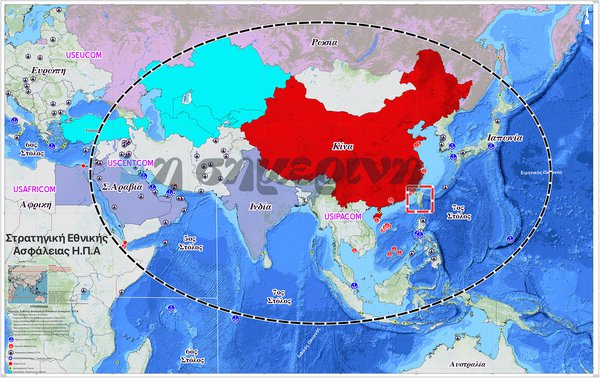
The map depicts the great game in the Indo-Pacific, where, according to the United States, 50% of global GDP is located. The balancing character of Turkey and the Turkic states, of Japan and of India — whose IMEC reaches Europe following the trace of the Unified Defense Doctrine in the Eastern Mediterranean — is evident. From the disposition of the 5th, 7th and 6th fleets, it is clear that the United States controls maritime commercial routes, strategically trapping China with the assistance of Japan and Taiwan. As for Europe, if the situation continues, the Americans give it twenty years before it loses its Western character.