
Turkey’s Helicopter and Drone Killer
Air Defense and Electronic Warfare Dome of “Attila”
The anti-aircraft system Hisar has been deployed in the occupied areas of Cyprus and operates in conjunction with other modern weapon systems directly connected to Turkey.
By Dr. Giannis Charalambidis
International Relations
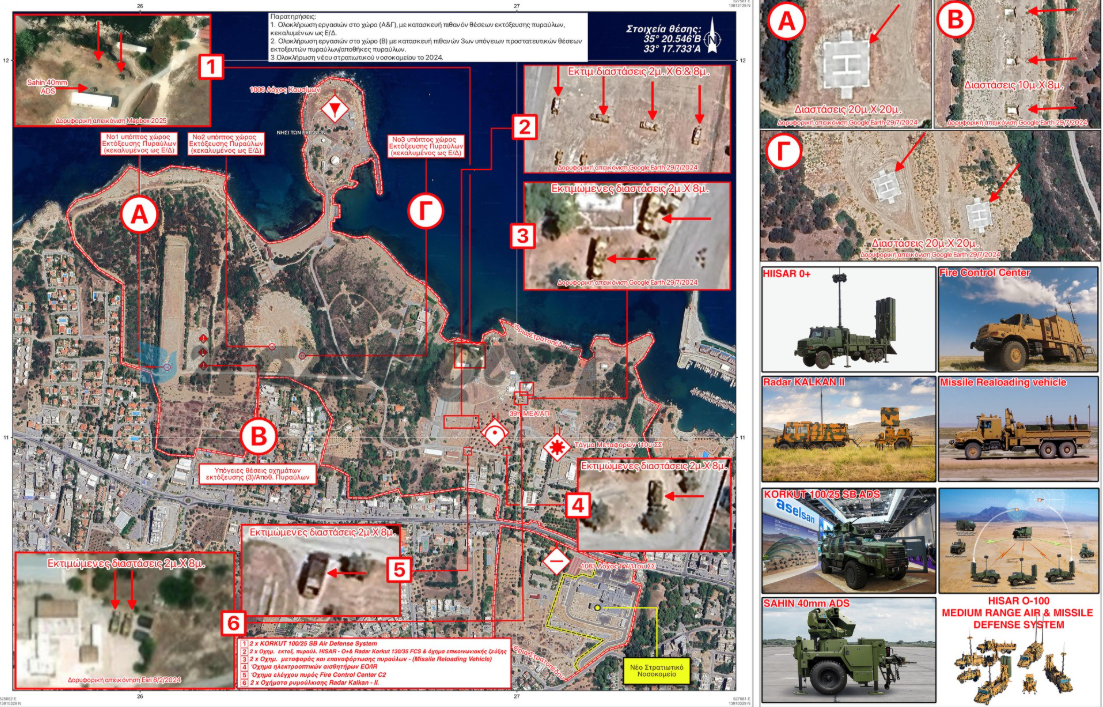
Turkey has proceeded with the deployment of a series of new weapon systems in the occupied areas of Cyprus, which form part of the so-called “Steel Dome.” Following the Korkut system, which Turkish forces showcased during the latest military parade in the occupied territories, the deployment of the Hisar anti-aircraft system has now been confirmed (see relevant satellite imagery).
Τουρκικός φονιάς ελικοπτέρων και drones
Base in Kyrenia
The Hisar air-defense battery—consisting of three launchers along with its auxiliary components, all of Turkish manufacture and origin—is presented as a killer of UAVs, drones, and especially aircraft and helicopters, including the French-made H145M helicopters of the National Guard. The Hisar battery is reportedly based in occupied Kyrenia.
It constitutes a third-layer, short-range air-defense weapon system designed to meet the demands of modern warfare. It is integrated into the broader network of Turkish air-defense domes, which are interconnected and linked to the central Command and Control (C2) system, HAKIM.
The Turkish “Brain”
What exactly is HAKIM? It is Turkey’s network-centric Air Defense Command and Control system, functioning as the central “brain.” It connects radars, sensors, and air-defense assets into a single unified network, providing a real-time aerial picture—who is flying, where, how, and with what threat characteristics.
Within this framework, HAKIM evaluates and prioritizes threats, including UAVs, aircraft, cruise missiles, and helicopters, and assigns engagement orders to the most suitable available weapon system. Decisions are made within seconds, eliminating duplicate engagements and coordination errors between different units. The system is designed to be resilient against electronic interference, significantly enhancing the effectiveness of all connected air-defense assets.
HAKIM cooperates with radars and electronic systems deployed on the Pentadaktylos mountain range—specifically at Hill 888, where the TRS-22XX radar with a surveillance radius of 500 kilometers is installed—and at Kioneli, where the STR-700G system operates with a radar range of 250 kilometers. It also integrates electro-optical sensors, electronic-warfare systems, and the radars of other air-defense systems deployed throughout the occupied areas.
This entire network is directly connected to Turkey via the HAKIM system.
Technical Characteristics
The Hisar system has its own radar, covering a radius of approximately 120 kilometers, allowing it to operate autonomously. At the same time, it is interconnected with other high-technology weapon systems deployed in occupied Cyprus, with its key feature being the mutual exchange and transmission of data and the synthesis of the threat picture.
Depending on the variant, missile range varies from 15 and 25 kilometers up to 40 kilometers, offering high target-engagement accuracy and resistance to electronic countermeasures. The system covers strategic and vital areas such as military bases, units, radars, ports, airports, and parts of the occupied Exclusive Economic Zone (EEZ).
It is capable of intercepting:
- UAVs (armed or unarmed, of any type)
- Loitering munitions
- Helicopters
- Aircraft
- Missiles in their terminal phase
It also conducts continuous airspace surveillance, transmitting and receiving real-time data via its own radar to the HAKIM command center in Turkey, as well as to other radars and weapon systems deployed across Cyprus—from Pentadaktylos to Kioneli—and to mobile units positioned near the confrontation line.
In this way, Hisar acts as a local air-defense hub, ensuring the protection of vital installations and force concentrations, while simultaneously restricting the effective operation of aerial assets and increasing the operational cost for the opposing side.
High Cost and National Guard Helicopters
What does “high cost” mean in practical terms? The National Guard has procured French-made H145M helicopters, which can carry two main categories of armament:
- Guided and unguided 70-mm rockets with a range of 5–7 kilometers, designed to engage light targets. These include unarmored or lightly armored vehicles such as jeeps, troop transport trucks, artillery positions, guard posts, lightly armored vehicles, and light fortifications.
- Guided anti-tank missiles (Spike ER2) with a range of up to 16 kilometers.
Under these conditions, it becomes evident that National Guard helicopters are vulnerable to the Hisar system due to its superior range, which restricts weapon release from safe stand-off distances.
Consequently, National Guard helicopters:
- Should avoid entering the kill zone (lethal or engagement zone), which extends approximately to the northern foothills of the Troodos mountain range.
- Remaining outside this zone significantly reduces their effectiveness in destroying enemy targets.
For the H145M helicopters to pose a serious threat, they would have to accept the high risk of entering the Hisar kill zone, with severe implications for their survivability.
The Hidden Eye of Kioneli
Operationally, Hisar is part of a unified network-centric system alongside the multi-role radar located in Kioneli—often described as the “eye of Attila.” This is the Turkish-made STR-700G radar, with a range of 250 kilometers, which:
- Is networked with artillery units, mortar units, air-defense assets, unmanned aerial vehicles—particularly drones—as well as with the long-range radar on Pentadaktylos (500 km) and smaller tactical early-warning radars such as the Serhat II / STR-400G.
- Transmits precise coordinates of the source from which a threat (shell or rocket) was launched, enabling immediate counteraction.
- Tracks projectiles and trajectories and selects the most appropriate weapon system for interception before the threat reaches its target.
- Automatically corrects artillery and rocket fire, replacing traditional human observation with real-time automated targeting.
Combined with other early-warning technologies, the STR-700G functions as a powerful force multiplier.
Electronic Warfare and Neutralization of National Guard Communications
Hisar, the STR-700G radar (250 km), Serhat II / STR-400G (25 km), KALKAN II (120 km), KORKUT KKA (70 km), and KORKUT FCS (70 km) are integrated with two state-of-the-art electronic-warfare systems:
A) VURAL ES/EA, a mobile electronic-support and electronic-attack system interoperable with HAKIM, providing electronic intelligence and receiving targeting and timing directives for electronic attacks.
B) PUHU-3 LT, mobile systems capable of detecting, monitoring, and geolocating enemy radio communications using advanced signal-analysis algorithms.
These systems can weaken—or even neutralize—the VHF/UHF communications of the National Guard.
VURAL is capable of:
- Conducting electronic interference against ground-based and airborne electronic systems.
- Blinding electronic surveillance displays and disrupting communications between command centers and field units.
- Detecting enemy radars and radio stations.
- Intercepting signals and transmitting intelligence for analysis and decision-making.
The Confrontation Line
The TRS-22XX radar and the VURAL–PUHU-3 LT electronic-warfare systems are interconnected with smaller systems deployed along the confrontation line within a 20-kilometer radius. VURAL has been operationally tested in both Libya and Syria.
The EU and Turkey’s Immunity
It is evident that even if opposing targets fall within the range of National Guard artillery, Turkey’s technological superiority and overall air dominance create serious operational challenges. These realities justify and necessitate further modernization of the National Guard to strengthen the credibility of deterrence.
The Hisar systems are illegal in Cyprus, just like the entire occupation force, and it is reasonable that this evidence be submitted:
a) On the 28th of the month before Ms. Holguín and Mr. Erhürman.
b) To the European Union, to demonstrate that the Turkish occupation and threat are not diminishing but intensifying.
If military assistance is being provided to Ukraine, should similar support not be requested in defense of the sovereignty of an EU member state? Are European partners solely responsible, or do domestic actors also bear responsibility for failing to demand what should be self-evident?
The EU claims to be in a comprehensive confrontation with Russia—and even with the United States in the Greenland issue. Why, then, does Turkey enjoy immunity?
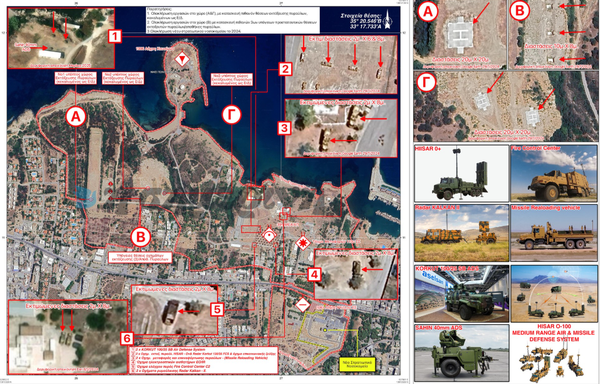
The composite satellite image also depicts works carried out in Kyrenia for the development of the “Hisar”.
Inset photographs:
- The Sahin 40 mm, a component of the “Hisar” for its protection.
- Two “Hisar” launchers, “Korkut”, a fire control system and a communications link vehicle (shelter).
- Two missile transport and reloading vehicles.
- Electro-optical sensor vehicle.
- Fire Control Vehicle.
- Radar towing vehicle “Kalkan II”.
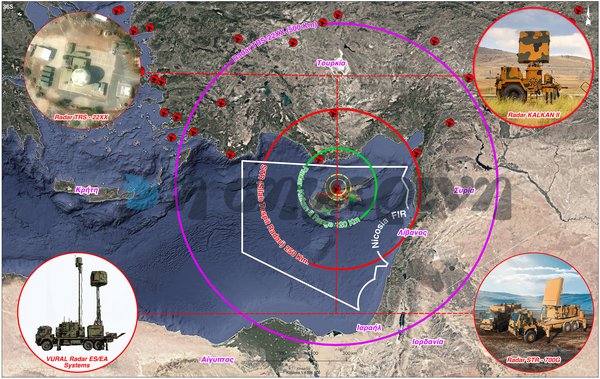
It depicts the Early Warning System.
In pink, the radar at Prophet Elias (elevation 888), with a range of 500 kilometers.
In red, the STR-E 700 G radar at Kioneli, with a range of 250 kilometers.
In green, the “Kalkan II” radar, with 120 kilometers.
In yellow, the firing range of the “Hisar” from 25–40 kilometers.
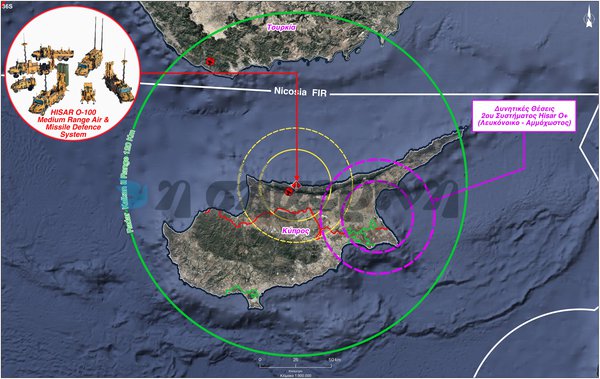
Certainly. Here is the English rendering, keeping meaning and structure intact:
In green, the “Kalkan II” radar, 120 kilometers.
In yellow, the ranges of the “Hisar” from 25–40 kilometers.
Potential location of a new “Hisar” unit toward the Famagusta area, for coverage of the entire occupied region.